×

The Standard e-Paper
Home To Bold Columnists
 The Standard Group Plc is a
multi-media organization with investments in media platforms spanning newspaper
print operations, television, radio broadcasting, digital and online services. The
Standard Group is recognized as a leading multi-media house in Kenya with a key
influence in matters of national and international interest.

Audio By Vocalize
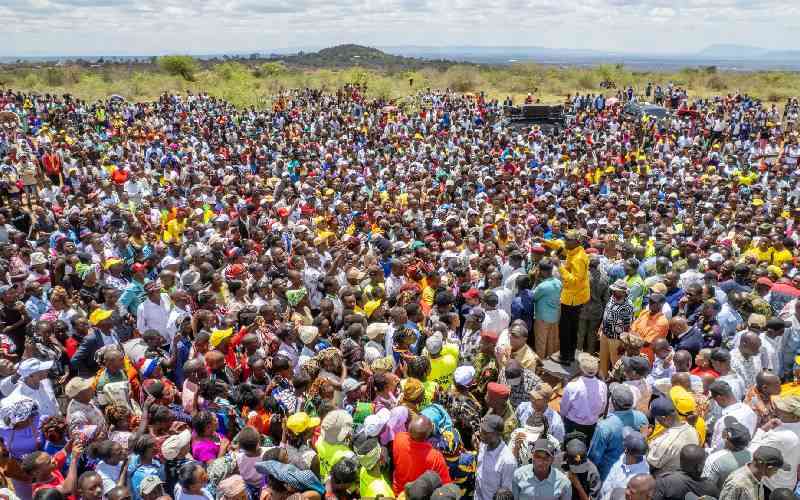
President William Ruto addresses residents after commissioning the construction of roads and last-mile connectivity in Masinga Constituency, Machakos County. [PCS]
This is a seesaw campaign between the incumbent and the united opposition. I still believe this election will be won or lost by a wide margin. By April next year, the ‘traitors’ will have handed themselves over to their master. The moles in the competing camps will have settled in one way or another. The line ups will have been determined, and the ‘also runs’ will be on the starting line, waiting for the gunshot.
I call it a seesaw campaign because the push and pull between the antagonists is bringing out the best comedy in them. It is a spectacle that keeps voters interested, even as the major issues dragging this country into corruption and poverty become thorny matters for the rival camps. One side is defending its record while the other is poking holes in the scorecard of the last four years. The blame games are intensifying as the stakes rise. The main camps are beginning to punch harder, seeking not only to draw crowds to their rallies but also to attract committed followers.
Yet some of the strategies being used to display political strength may produce the opposite of what their organisers intend. This is called the cobra effect: An incentive meant to achieve one purpose ends up encouraging behaviour that undermines it.
A story is told of snake bites that were increasingly becoming a problem in colonial New Delhi India. The government decided to offer rewards to whoever will bring dead cobras. Unknown to the government, this policy encouraged some people to breed more snakes for the reward. When the reward was withdrawn, people stopped breeding the snakes. The policy had created more of the problem it was meant to solve.
Look at the crowds at political rallies. Many Kenyans attend because they genuinely support a candidate or a cause. Others, it is alleged, are paid by agents to attend. The aim is clear: Fill the grounds, create an impression of strength and show that the people are behind the political leadership. The purpose is to gain reliable voters. But, hired crowds are increasingly becoming transactional and unreliable. We have seen many times hired crowds discrediting the very camp they were meant to promote.
That is the political cobra effect. Payment may help fill a rally, but it cannot buy conviction. If organisers rely on numbers produced by cash incentives to judge the public mood, they risk believing their own display. And when people come to see rallies as events attended for payment rather than out of belief, the spectacle of popular support can begin to look hollow. The effort to demonstrate strength may expose the weakness of the connection between leaders and the people.
The same effect can be seen in the way political support is built through ethnic alliances. Kenya’s politics often revolves around communities, their leaders and the promise of influence in government. Positions may be dangled to secure support while smaller communities shift their allegiance towards whoever they believe might treat them more sympathetically. These political bargains are often presented as a way to build a broad coalition and give different groups a stake in power.
But the bargain can deepen the competition it is supposed to contain. When communities are made to believe that access to power depends on bargaining through their leaders, politics becomes a contest over which group can secure the greatest share. Those who receive positions may feel included, while those left out can feel ignored. Smaller communities, uncertain that any alliance will protect their interests, may keep moving from one camp to another in search of influence. In trying to hold coalitions together through rewards, leaders can reinforce the very ethnic rivalry and insecurity that make those coalitions necessary.
To avoid the cobra effect, they must campaign on issues that serve the country as a whole: Confronting corruption, reducing poverty and setting out credible plans to improve people’s lives. The test of a campaign should not be the size of its crowds or the number of communities represented in a deal, but whether its ideas can unite Kenyans around the national interest.
- Dr Mokua is Director Loyola Centre for Media and Communications






Subscribe to our newsletter and stay updated on the latest developments and special offers!