×

The Standard e-Paper
Home To Bold Columnists
 The Standard Group Plc is a
multi-media organization with investments in media platforms spanning newspaper
print operations, television, radio broadcasting, digital and online services. The
Standard Group is recognized as a leading multi-media house in Kenya with a key
influence in matters of national and international interest.
The Standard Group Plc is a
multi-media organization with investments in media platforms spanning newspaper
print operations, television, radio broadcasting, digital and online services. The
Standard Group is recognized as a leading multi-media house in Kenya with a key
influence in matters of national and international interest.

Audio By Vocalize
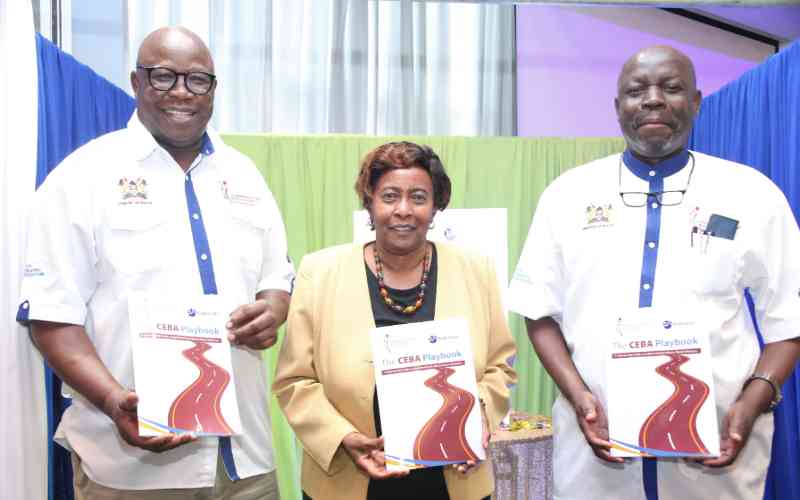
Kenya continues to grapple with gaps between well-written health policies and what is actually delivered on the ground, a disconnect that has slowed progress in maternal, newborn and child health outcomes despite years of investment.
It is this persistent challenge that has driven the development of a new advocacy guide aimed at helping counties and health actors turn evidence into action.
The Kenya Paediatric Research Consortium (KEPRECON) is set to launch the Championing Evidence-Based Advocacy (CEBA) Playbook, a practical guide documenting lessons from a four-year project implemented between November 2021 and March 2026.
The playbook focuses on strengthening Primary Health Care and Reproductive, Maternal, Neonatal, Child and Adolescent Health and Nutrition (RMNCAH+N). It outlines how local partners can better use data, push for policy implementation and hold governments accountable.
Dr Dan Odallo, CEBA Technical Lead, said one of the biggest gaps has been the failure to translate policies into meaningful action. “We have a lot of policies in our country and these policies are usually not put to full use,” he said. “We tried in the CEBA project to bring these policies together and to talk to policymakers, making sure that the policies were talking to the realities on the ground and also influencing decision-making.”
He added that the project focused on training county-level health workers to engage with their own data and use it to advocate for increased funding. “We have challenges with maternal care, with maternal deaths, we have challenges with child survival, but unless we are able to make sure that our resources are also addressing those challenges, we will not make any progress,” he said.
According to Prof Fred Were, CEO of KEPRECON and CEBA project lead, the initiative was informed by Kenya’s slow progress towards global health targets. “Our main concern was that we are not translating the policies we write into the parties that can make a difference,” he said. “This project aimed to simplify the complexities that are generally called policies and guideline into simple messages that one can understand.”
The project initially targeted 15 counties including Kirinyaga, Taita Taveta, Mandera and Migori, before expanding its influence nationwide. Prof Were noted that while some improvements have been recorded, gaps remain, particularly in newborn health.
Findings from the project show that progress varies widely across counties. Dr Nelly Bosire, a technical lead in the project, pointed to counties where strong collaboration between health teams and leaders has led to tangible change.
“We are sitting here and looking at counties like Taita Taveta and Vihiga where there is a lot of open communication. We have seen policies that have actually been put in place,” she said.
In Vihiga, she noted, a County Nutrition Act has been enacted, ensuring sustained funding regardless of political leadership. Other counties have focused on strengthening primary health care systems based on local needs.
Nutrition remains a critical but under-addressed area. Henry Ng’ethe, President of the Nutrition Association of Kenya, warned that preventive investment is still lacking. “If a particular individual is deficient of a certain micronutrient, it basically means that even the foetus will also come out as deficient,” he said, adding that “one dollar that is invested in nutrition gives you up to around 22 dollars.”
Health workforce constraints also continue to affect service delivery. Collins Otieno Ajwang, President of the National Nurses Association of Kenya, said staffing shortages limit quality care. “One nurse cannot take care of 15 mothers in our maternity units. It is practically impossible,” he said, noting that data is now being used to push for more hiring.
Clinical officers, often the first point of contact in health facilities, have also played a central role. Moses Konde Matole, President of the Kenya Clinical Officers Association, said the playbook offers a structured path forward.
“It is a step-by-step basis on how we can intervene on RMNCAH+N indicators,” he said, while urging governments to address preventable issues such as late referrals and lack of essential supplies.
Stay informed. Subscribe to our newsletter







Subscribe to our newsletter and stay updated on the latest developments and special offers!








 join
join