×

The Standard e-Paper
Fearless, Trusted News
 The Standard Group Plc is a
multi-media organization with investments in media platforms spanning newspaper
print operations, television, radio broadcasting, digital and online services. The
Standard Group is recognized as a leading multi-media house in Kenya with a key
influence in matters of national and international interest.
The Standard Group Plc is a
multi-media organization with investments in media platforms spanning newspaper
print operations, television, radio broadcasting, digital and online services. The
Standard Group is recognized as a leading multi-media house in Kenya with a key
influence in matters of national and international interest.

Audio By Vocalize

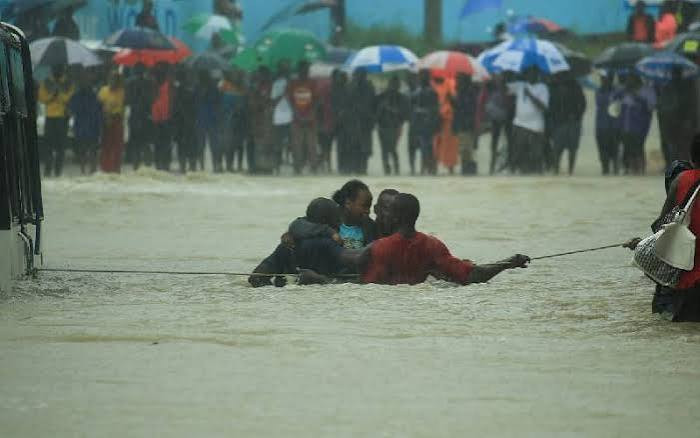
Watermelon farm destroyed by floods. [File, Standard]
The world marked World Environment Day on 5 June, a moment that shines a spotlight on a reality communities are already living through. Climate change is no longer a distant threat; it is reshaping lives in real time, determining where people can live, how they earn a livelihood, and whether they can remain in the places they call home. Each day, families lose homes to floods and storms, while prolonged droughts wipe out crops and livelihoods. Entire communities are caught in a cycle of repeated shocks, forced to rebuild repeatedly.
In Kenya, this year’s commemoration was accompanied by a sign of cautious progress. The country’s recent breakthrough, becoming the first in Africa to receive climate disaster funding through the Santiago Network on Loss and Damage, marks an important turning point. The Sh90 million allocation is modest, but its true significance lies in what it demonstrates: that loss and damage finance can be mobilised, that affected communities can be clearly identified, and that funding can be channeled with purpose.
For financial institutions, this is more than a milestone worth acknowledging. It is a clear signal of where the future of capital is heading and what it will take to access it. The central lesson is not about the amount disbursed, but about readiness. Climate finance is increasingly available, but it is not passively distributed. It flows to institutions that can demonstrate structure, credibility, and impact on a scale. Kenya’s experience shows that when needs are clearly defined and aligned with real communities, funding follows. The task ahead is to replicate and expand this model, transforming isolated successes into sustained financial flows.
To do this, financial institutions must first move decisively beyond pilot projects and fragmented interventions. Climate finance does not respond to scattered ideas; it seeks well-prepared, bankable pipelines. Institutions must therefore invest in developing structured portfolios of projects, whether in renewable energy, climate-smart agriculture, resilient infrastructure, or water systems that can absorb funding at scale. This requires standardised documentation, clear performance metrics, and an ability to demonstrate both financial viability and measurable climate impact. Without this discipline, opportunities for funding will remain out of reach.
Equally important is the integration of climate risk into core business decisions. Climate change is no longer a distant environmental concern; it is a material financial risk affecting credit quality, asset values, and long-term profitability. Institutions that embed climate considerations into their lending frameworks through stress testing, risk pricing, and portfolio alignment signal to global funders that they understand the realities of a changing climate. This credibility is increasingly a prerequisite for attracting capital, particularly from climate-focused funds and development partners.
However, readiness cannot exist only at the institutional level; it must extend to the communities that climate finance is intended to serve. One of the most powerful lessons from Kenya’s funding breakthrough is that finance is most effective when it reaches the last mile. Financial institutions must therefore design products that are accessible to smallholder farmers, microenterprises, and vulnerable households, those on the frontlines of climate shocks. Flexible credit, microinsurance, and asset financing for green technologies are not just social interventions; they are essential mechanisms for unlocking concessional and blended finance, which increasingly prioritises inclusion alongside impact.
At the same time, institutions must become more adept at leveraging blended finance structures. Climate funding rarely comes in isolation; it is often layered through partnerships that combine public, private, and philanthropic capital. To attract such funding, financial institutions must actively engage with development finance institutions, utilise guarantees, and structure investments that reduce risk while maintaining returns. About two months ago, Absa Kenya Foundation partnered with GIZ and AGF to launch Kenya’s first and largest CirculaRising Programme targeting MSMEs and SMEs that are women- and youth-led. This programme targets creation of over 6,000 new and improved jobs in the next 2 to 3 years.
Transparency and accountability will also determine which institutions succeed in attracting climate capital. Global climate finance is governed by increasingly rigorous expectations around reporting, impact measurement, and governance. Net-zero pledges and sustainability commitments can no longer remain aspirational; they must be backed by clear targets, timelines, and verifiable outcomes. Institutions that invest in robust environmental, social, and governance frameworks and openly report on progress build the trust necessary to unlock long-term funding.
Alignment with national and global priorities further strengthens this position. Kenya’s progress demonstrates the importance of policy coherence in attracting climate finance. Financial institutions that align their strategies with national frameworks, such as green finance taxonomies and climate action plans, are better positioned to access coordinated funding streams. This alignment reduces uncertainty, signals strategic intent, and ensures that investments contribute to broader development goals.
Finally, there is a need to focus intentionally on small and medium enterprises, which form the backbone of Kenya’s economy but remain significantly underfunded in the climate transition. By providing tailored financing solutions supported by technical assistance and risk-sharing mechanisms financial institutions can unlock the potential of SMEs to drive climate resilience. When these businesses are equipped to adopt green technologies and expand sustainably, climate action shifts from isolated projects to systemic transformation, making it far more attractive to global funders.
Kenya’s access to loss and damage funding is therefore not an endpoint, but a proof of concept. It shows that climate finance can work when the right structures are in place. For financial institutions, the implication is clear: attracting climate action funding is not about waiting for external commitments to materialise, but about building the internal capacity, partnerships, and credibility that make investment inevitable.
Those institutions that act with urgency by developing bankable pipelines, embedding climate risk, reaching underserved communities, and embracing transparency will not only access the growing pool of climate capital, but will also play a defining role in shaping Africa’s climate resilience journey.
- The writer is the vice president - head of sustainability, communications and corporate relations at Absa Bank Kenya
Stay informed. Subscribe to our newsletter





Subscribe to our newsletter and stay updated on the latest developments and special offers!








 join
join